A Distant Place
“A Distant Place,” ink on rice paper, from A Distant Place, 1985


“A Distant Place,” ink on rice paper, from A Distant Place, 1985
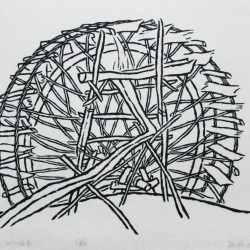
“A Distant Place,” woodcuts, from A Distant Place, 1985
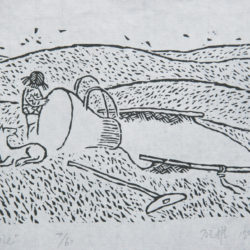
In 1972, at the height of China’s Cultural Revolution, I was sent to the rural village of Qingping, located in the mountains of northwestern Sichuan province. I was seventeen years old. I was sent, along with millions of youth from urban centres, to isolated farming communities to be “re-educated” by “peasants,” who were viewed as[…]
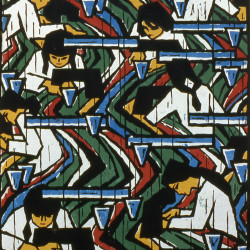
“Memories from the ’70s to ’80s,” woodcuts, 1978-1987

“Re-educated Youth in the Countryside,” sketchbooks from the Cultural Revolution, 1972-1976 I was one of the millions of youth who were sent to the countryside from 1972-1976. There was no hope for our future, only hard work. Under oil light, I found my inner identity through these sketches in my darkest time. For four years, I[…]

I was a sent down youth in the countryside and later a worker in fabric factory. This was the time when art started to carry meanings in my life. It helped me to search for inner self, to hold onto myself, so that I could get past the darkness and eventually reach the light. Photos[…]
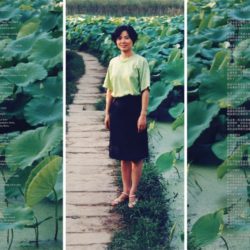
We know it was hard but we can never know how hard for how hard could it be for a woman with such a smile? In Canada, when two cars collide we call the people inside accident victims. In Canada, when two cultures collide we call the people in them immigrants. Both are heavy with[…]

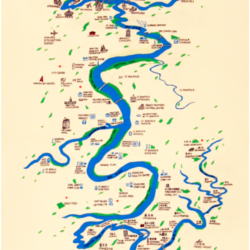
This essay is an excerpt from the catalog for Red River, an exhibition at the Winnipeg Art Gallery. Our understanding of place, history, time, identity, and memory is increasingly undergoing transformation within the new economy and culture of globalization. This landscape of shifting spaces of local cultures is caught up within rapid economic, political, and technological change. Globalization is[…]
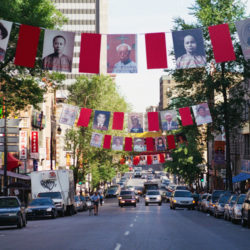
“Cultural Identity” has become a catchphrase nowadays. In English, the phrase is often heard of. When translated into Chinese, however, it becomes foreign and strange. It reminded me of the Chinese citizenship ID card for no apparent reason. When I was an “educated youth”, even though I was a proud “communard”, I didn’t have a[…]

My family Under the clouds Moves from one land to another Struggling between cultures Not knowing to which we belong Even though the flowers are falling The fruits will appear later When the maple leaves rest On the ground My family finally settles down We are like seeds In the depths of this land Absorbing[…]

Each time I see you, I see myself; I see the past and the present. We both came from China, You stayed inside the grand institution, I stayed in a dark basement. People came to admire you, But can you hear their praise? Or speak your gratitude? I could hear, but I couldn’t speak. I[…]

While revealing his sketches for a proposed series of paintings based on crushed cans, Gu Xiong said that common objects look dead, and are only made to come to life when they are “Killed.” A neat irony, one that can take off in many directions. Discarded cans of pop, cafeteria trays, dirty kitchen utensils (his[…]
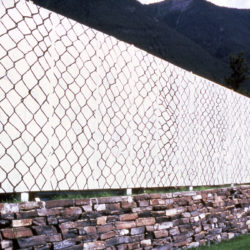
When I break through the enclosures, I find that I am still in the enclosure. Because disturbance exists for humans, they make many enclosures for themselves. It becomes an emblem of their culture and an emblem of isolation and oppression. Facing the Great wall, the Paris Bastille Wall and the Berlin Wall: we understand the[…]


The Yangzi River flows out of the mountains in the Qinghai Plateau, rushing through valleys and plains, coalescing with the vast Pacific Ocean. A river dashes out of the cosmic order of ancient Chinese philosophy. The red wall of the gallery, through embodying multiple connotations, reminds one of the lifeblood and magnifies the immeasurable energy[…]